SomniAI shares the personal experience and PSG-paired acoustic research behind its work to make nighttime breathing irregularities easier to detect and understand.
Sheridan, WY (PRUnderground) November 12th, 2026
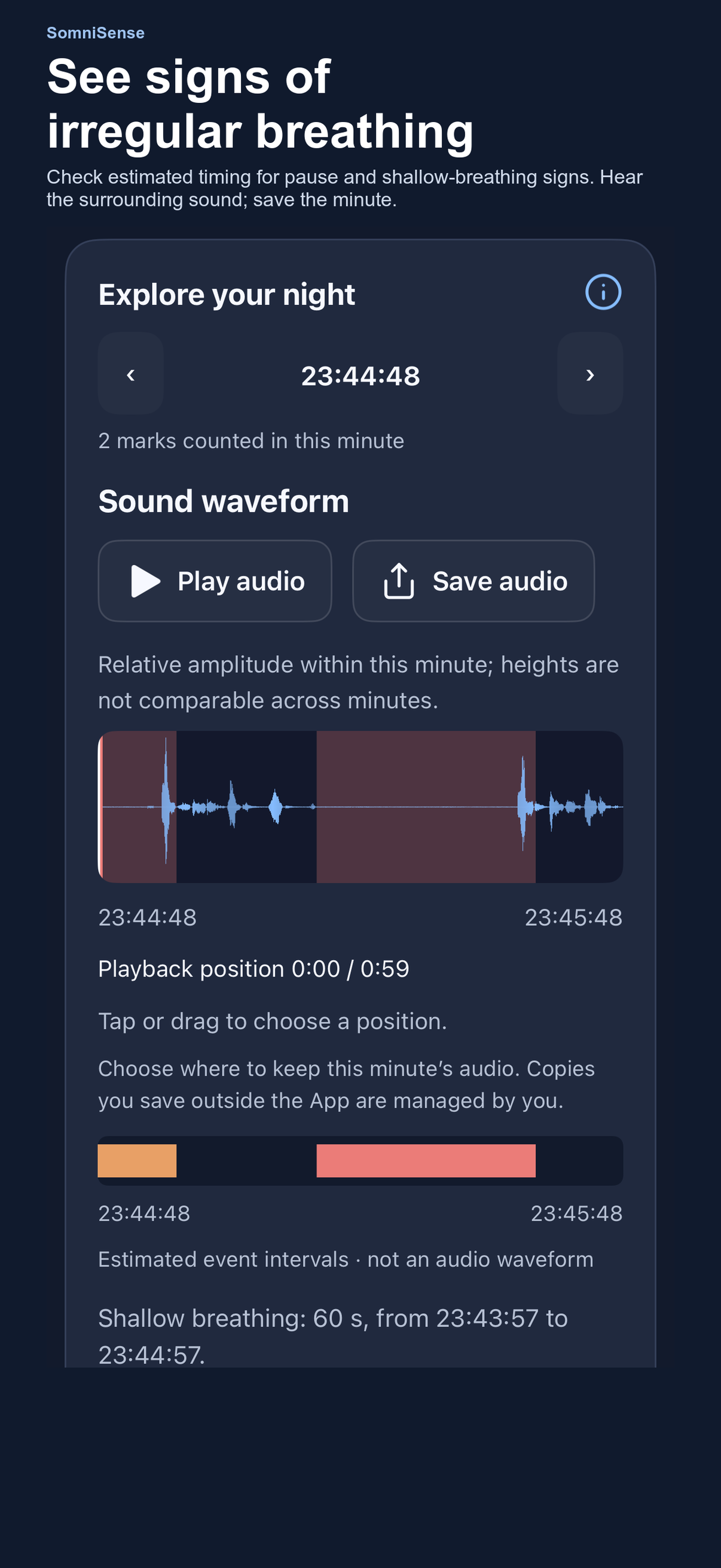
SomniAI LLC is sharing the personal experience and acoustic research behind SomniSense -- Sleep Apnea Detector, its app for iPhone and Android. For people searching for a "sleep apnea test at home" who want to understand their nighttime breathing, SomniSense offers a way to begin everyday observation using a phone they already own: analyzing sleep sounds, presenting detected breathing irregularities, and letting users inspect and listen to the corresponding moments. It supports personal observation and does not replace a clinical home sleep apnea test or polysomnography (PSG).
The development of SomniSense began with a personal concern. Young Lee's wife told him that he snored heavily and sometimes appeared to stop breathing during sleep. He also felt dizzy on waking and still felt sleepy despite having slept for many hours. A subsequent medical examination confirmed moderate-to-severe obstructive sleep apnea (OSA).
After the diagnosis, Lee changed his daily habits and tried anti-snoring pillows, sleeping on his side and nasal strips. He wanted to know whether these efforts were making a difference to his nighttime breathing. But polysomnography (PSG) examinations required appointments and waiting, making frequent testing impractical for his day-to-day observations and comparisons across nights.
This led Lee to explore whether the phones people already owned could be used to develop an app that would help them detect breathing irregularities in everyday use and follow changes over time. SomniAI's acoustic research and the development of SomniSense grew from that idea.
"Our aim is to make breathing irregularities during sleep easier to detect and understand, with technology more people can afford to use. SomniSense is how we are putting that purpose into practice," said Young Lee, founder of SomniAI LLC.
Building on early research for the long term
SomniAI's development work builds on earlier research papers and three U.S. provisional patent applications covering sleep sound analysis, breathing-irregularity detection and related technical methods.
In its earlier research, the company analyzed 2,953 audio segments from 80 person-nights across 40 participants. Each segment was 200 seconds long and paired with polysomnography (PSG) annotations. This work provided a basis for developing and evaluating the related acoustic methods. The methods and papers are available through the company's research overview (https://somnisense.top/research/). The findings relate to the specific research tasks described in the papers, rather than establishing clinical accuracy for every event detected by the current app.
Building on this work, SomniAI sees collaboration with more clinics and users as an important direction for its long-term research. The company aims to connect research with the practical needs of everyday use, continue exploring breathing changes across nights, and make detection tools more useful, easier to understand and affordable to more people.
Answering everyday questions about nighttime breathing
These experiences also led SomniAI to focus its product development on questions people face in everyday life: whether they snore, whether breathing irregularities occur at night, how often they appear, what they can learn beyond existing device readings, what changes across nights, and how easily they can start recording.
For people who do not know whether they snore, recordings make those sounds available to review. Whether they sleep alone or have been alerted by a partner, users can see detected snoring and listen to recordings to understand what they sound like while asleep. Snoring detection, playback and export of available snoring audio are free.
For people concerned about sleep apnea, the report helps them understand what was detected during their night. SomniSense -- Sleep Apnea Detector analyzes sleep sounds recorded by a compatible phone beside the bed and marks possible breathing pauses or shallow-breathing patterns in a breathing-irregularities report. Snoring and breathing irregularities are presented separately, helping users distinguish the different findings.
For people who want to know how often irregularities occur and when, the report connects the overnight picture to individual events. Users can review the number of detections, their timing and estimated duration, then go directly to the corresponding waveforms and available surrounding audio without searching through hours of recording. This presentation of events by timing and duration shares similarities with event records in PSG reports, making it easier to move from an overnight overview to specific moments.
For people who already use a watch or ring, sound offers another way to understand their night. Alongside their existing device readings, users can review audio independently recorded and analyzed by the phone, listening to what happened around marked moments. The records offer different perspectives; SomniSense does not import or automatically match wearable events.
For people who have already been diagnosed or are adjusting their daily habits, repeated recordings make nights easier to compare. With Pro's complete reports and multi-night comparisons, users can observe whether similar patterns recur. They can also choose to record habits such as side sleeping, alcohol consumption or changes in routine when reviewing differences across nights. Audio export and PDF reports make the records easier to save, revisit and share. These observations help users follow changes, but differences alone cannot establish whether a particular approach had a therapeutic effect.
For people who want to try it, getting started requires only a compatible phone. There is no additional device to buy or wear: users place the phone beside the bed, complete an overnight recording and review the results after analysis. The first qualifying complete breathing-irregularities report is free. If a recording does not qualify, users can keep trying at no cost. Recording and analysis remain free afterward, while subsequent complete reports and multi-night comparisons require Pro.
About SomniAI LLC
SomniAI LLC develops SomniSense and conducts research into audio-based sleep breathing analysis. Its work connects acoustic methods with records that people can inspect, listen to and revisit. SomniSense is available for iOS and Android and supports English, Traditional Chinese, Japanese, Korean, Spanish, French and German.
Company and product information: https://somnisense.top/
Research and papers: https://somnisense.top/research/
Media contact
Young Lee
SomniAI LLC
support@somnisense.top


