New architecture connects Cortex, Codex, Copilot, Claude, Gemini, and OpenCode with protected credentials, governed execution, and continuity across enterprise workflows.
San Francisco, CA (PRUnderground) October 13th, 2026
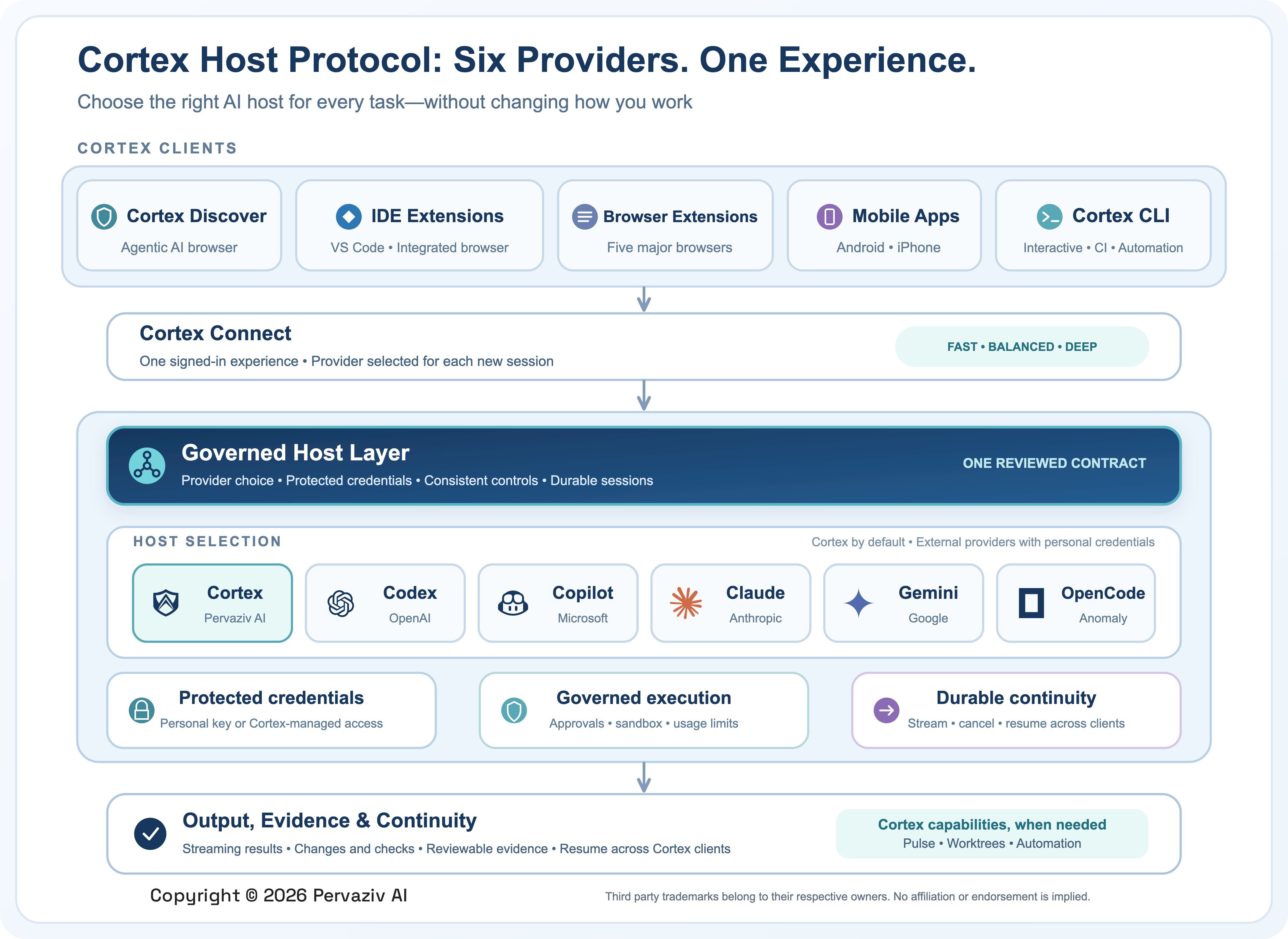
Pervaziv AI, an enterprise artificial intelligence and cybersecurity company, today announced Cortex Host Protocol, a new architecture that lets organizations use six AI hosts through one consistent Cortex experience across browsers, development environments, mobile devices, and the command line.
Cortex Host Protocol introduces a common host layer for Cortex, OpenAI Codex, Copilot, Anthropic Claude, Google Gemini, and OpenCode from Anomaly. Users can select the host that fits a new session without rebuilding how they access AI, manage credentials, control execution, or continue work.
The launch addresses a growing enterprise problem. Organizations are no longer choosing a single AI system. Developers and teams increasingly work across several providers, each with different interfaces, accounts, permissions, billing relationships, and execution models.
More AI choice can quickly create more operational fragmentation.
Cortex Host Protocol is designed to separate those two things.
"Enterprises should be free to choose the best AI for the work without rebuilding around every provider," said Anoop Jaishankar, Founder and CEO of Pervaziv AI. "Cortex makes provider choice a platform capability, not another source of fragmentation."
Six Providers. One Cortex Experience.
Most multi-model products begin with a model selector.
Cortex Host Protocol goes further by creating a common operating layer around the selected AI host.
A user can begin with Cortex or choose Codex, Copilot, Claude, Gemini, or OpenCode for a new session. The provider may change, but the surrounding Cortex experience remains familiar.
Cortex Connect handles the relationship between the client and the selected host. Credentials stay protected. Execution operates within defined boundaries. The session retains its host identity. Results can continue into the broader Cortex platform when more advanced workflows, verification, automation, or security capabilities are needed.
This changes provider choice from an interface feature into an architectural capability.
One Host Layer for a Fast Moving AI Market
AI providers are releasing models and agent capabilities at a pace that makes a fixed enterprise AI stack increasingly difficult to maintain.
The strongest provider for a coding task today may not be the strongest provider six months from now. Organizations may already have Microsoft entitlements, OpenAI access, Anthropic relationships, Google infrastructure, or an open source strategy.
Cortex Host Protocol gives enterprises a way to preserve those investments while creating a stable layer above them.
The initial host choices include:
Cortex by Pervaziv AI is the native and default host, connecting users with Cortex intelligence, routing, security, validation, and broader enterprise capabilities.
Codex by OpenAI provides an OpenAI powered path for software development and coding agent workflows.
Copilot by Microsoft allows organizations with existing Microsoft development investments and entitlements to bring that host into the Cortex experience.
Claude by Anthropic provides another option for coding, analysis, technical investigation, and complex work.
Gemini by Google brings a Google AI option for organizations and users with approved Gemini access.
OpenCode by Anomaly adds an open source host option that can operate with configured upstream models and credentials.
Cortex does not attempt to make six different systems behave identically. Their capabilities, economics, and underlying architectures remain different.
Instead, Host Protocol establishes a consistent contract around how those systems enter enterprise work.
That distinction is important. Cortex does not flatten the AI market. It creates a stable layer above it.
Protected Credentials Without Credential Sprawl
Multi-provider AI becomes difficult to manage when every application becomes another place to configure and store access credentials.
Cortex Host Protocol separates the client experience from the provider secret.
Organizations can support approved personal credentials or Cortex-managed access depending on policy and provider configuration. Users can see whether a session is operating through their own credential, centrally provided access, or requires an eligible account before it can begin.
The billing relationship remains clear as well.
A personal credential continues to use the provider relationship associated with that account. Managed access follows the limits and policies established by the organization.
If access expires or is revoked, Cortex does not silently substitute another payer or provider.
That makes credential ownership part of the session contract rather than hidden infrastructure.
Control the Host, Not Just the Prompt
AI governance becomes considerably harder when every provider defines its own operating boundary.
Cortex Host Protocol places an additional control layer around the host session.
Organizations can determine which providers are available, where they can operate, what workspace access is permitted, which actions require approval, and what usage limits apply.
Those boundaries can also reflect the client.
An IDE or Cortex CLI session can support approved project activity when the environment provides the necessary controls. Browser and mobile experiences can use more restrictive access when appropriate.
The same provider name therefore does not automatically imply the same authority everywhere.
This gives enterprises a stronger model than simply approving a vendor. They can approve how that provider participates in work.
Unsupported capabilities remain outside the allowed boundary rather than being assumed available.
Sessions That Know Who Is Running Them
Provider choice introduces another problem that becomes easy to overlook: session identity.
If work starts with one host, silently moving the conversation to another can change behavior, cost, available capabilities, and the meaning of the resulting transcript.
Cortex therefore binds a session to its selected host and credential context.
A user can choose another provider when beginning a new session, but an active session does not quietly migrate between providers.
Reconnection preserves the relationship. Recovery retains ordered progress. A resumed session does not attach itself to another account simply because another credential is available.
This extends the continuity principles already being developed across Cortex.
Continuous intelligence is not only about keeping work alive. It is also about preserving who acted, under what authority, through which system, and with what evidence.
Fast, Balanced, and Deep Instead of Model Menu Sprawl
Host choice answers one question: Which AI environment should run this session?
Users still face another: How much capability does this task need?
Rather than exposing an ever changing catalog of model versions, Cortex presents three understandable response modes.
Fast prioritizes responsiveness for direct questions, explanations, transformations, and focused tasks.
Balanced is designed for everyday coding, research, analysis, and normal technical work.
Deep gives difficult investigations, architecture decisions, and demanding objectives more room for reasoning.
Cortex can map reviewed capabilities behind those modes as providers evolve.
That allows the underlying AI market to keep changing without asking every employee to become a model release expert.
The provider determines where the intelligence comes from. The mode expresses how the user wants the task approached.
Choose the AI. Keep the Workflow.
Host Protocol extends across the primary Cortex client experiences.
Cortex Discover provides the browser native experience for web research, page context, and controlled browser work.
IDE extensions bring host selection into development workflows.
Browser extensions extend Cortex across supported browsers already used by teams.
Mobile applications provide access and continuity through Android and iPhone.
Cortex CLI brings the same architecture to interactive terminal work and automation.
Cortex Connect holds these surfaces together.
The clients do not each become separate provider orchestration systems. External provider credentials do not need to be duplicated across every interface. Host session behavior does not need to be rebuilt independently for every device.
That is where Host Protocol becomes more significant than a six provider selector.
From Vendor Choice to Strategic Leverage
For technology leaders, Host Protocol turns AI optionality into leverage.
Teams can adopt a stronger provider, respond to pricing or capability shifts, preserve existing vendor investments, and evaluate new AI systems without redesigning the surrounding experience each time the market moves.
For security leaders, it creates a common control point across otherwise different AI systems. A provider can be enabled, constrained, observed, or disabled without creating another unmanaged path into enterprise work.
For developers, the benefit is immediate: choose the host that fits the task and keep working. The provider can change from session to session without forcing a change in tools or the path back into Cortex.
The result is a different kind of portability.
It is not merely the ability to call several models through one API.
It is the ability to let intelligence change while keeping the enterprise operating model intact.
Provider Choice Without Leaving Cortex Behind
External hosts also do not turn Cortex into a thin routing interface.
A host session can remain connected to the broader capabilities available across the Cortex platform when the work expands.
Cortex Pulse can track changing objectives and approved sources. Workflow Recipes and Automations can turn successful work into repeatable processes. Managed worktrees can isolate parallel engineering efforts. Cortex Cloud can provide durable execution where policy allows. Cortex Discover can bring live browser context into an objective. Security, validation, and evidence capabilities can help determine whether work is actually complete.
Not every host needs every capability.
The architectural advantage is that choosing another AI provider does not require abandoning the Cortex environment and reconstructing the workflow later.
Provider choice becomes an entry point, not an exit.
The Next Layer of the Cortex Architecture
Cortex has continued to expand from individual AI assistance toward an Enterprise AI Control Layer for work that spans tools, environments, and longer running objectives.
Cortex Pulse strengthened continuity across time.
Cortex Connect strengthened continuity across clients and enterprise systems.
Cortex Host Protocol now extends that principle to the AI providers themselves.
The market can change underneath the experience.
A new model can become the preferred option. An enterprise can change vendor strategy. A provider can be restricted. A new open source host can emerge. A team can choose different intelligence for different objectives.
The enterprise should not have to rebuild its operating model every time that happens.
Cortex remains the native default while Codex, Copilot, Claude, Gemini, and OpenCode expand the choices available around it.
Users choose the intelligence appropriate for the task. Organizations retain a consistent layer for access, execution, continuity, and control.
Six Providers. One Cortex Experience.
The AI can change. The way the enterprise works does not have to.
For more information about Cortex and Pervaziv AI, visit pervaziv.com.
About Pervaziv AI
Pervaziv AI develops enterprise artificial intelligence and cybersecurity technologies designed to help organizations build, secure, and operate software with greater intelligence and control. Cortex brings together AI models, specialized agents, security, development, browser, cloud, and connected workflow capabilities through an Enterprise AI Control Layer.
Third Party Products and Trademarks: OpenAI, Codex, Microsoft, Copilot, Anthropic, Claude, Google, Gemini, OpenCode, and other third party names and trademarks are the property of their respective owners. References indicate supported interoperability or access and do not imply affiliation, sponsorship, endorsement, or approval of Pervaziv AI or Cortex. Third party services are subject to their respective terms, availability, and applicable fees.


